Showing posts with label Justin O'Byrne. Show all posts

Friday, 23 March 2018

Remembering the Great Escape

Much has been written about the Great Escape: what occurred on the night; what happened to those involved; and the commitment to obtaining ‘exemplary justice’. 
Artist: Ley Kenyon, published in Paul Brickhill and Conrad Norton: Escape to Danger (Faber and  Faber, London,  1954). 
 This post, however, focuses on how the airmen’s kriegie friends and Australian families responded to their deaths.
Courtesy Chris Armold, MSgt, USAF (Ret). Taken in March 2017.
Alan Righetti, who had been one of the many ‘stooges’ or lookouts over the previous few months, remembered hearing the shots fired after the discovery of the break out. It ‘was pandemonium’, he recalled, as the Germans tore the North Compound apart. When things quietened down, the airmen ‘were bitterly disappointed that we hadn’t got at least 200 out’. But, Righetti added, they were, ‘at the same time, very proud of the fact that we had the whole of the area and the German Army rushing all over the place looking for our fellas’.
Alan Righetti, courtesy of Alan Righetti
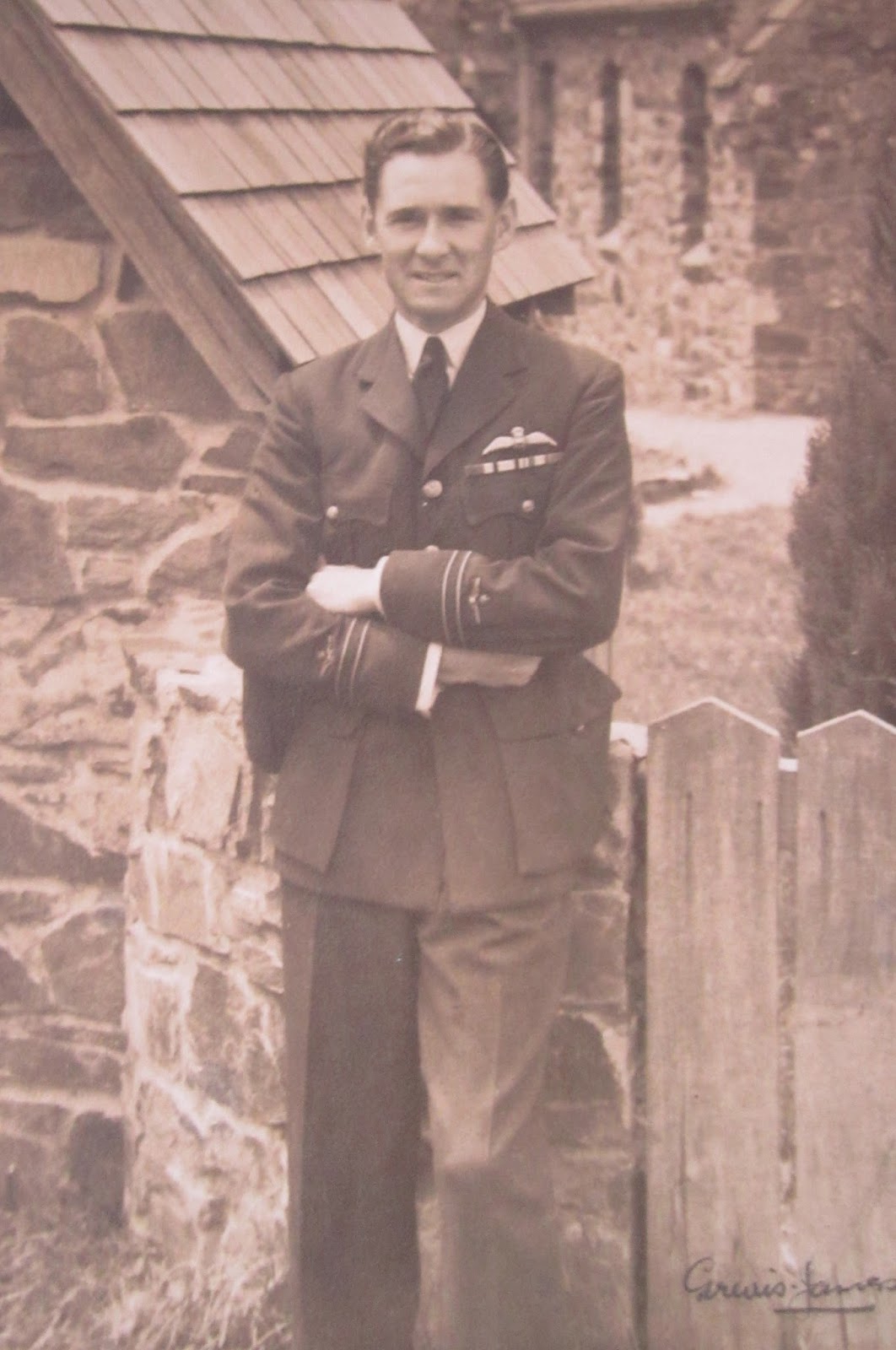
Days later, when the names of the dead were announced, Righetti recollected that ‘we were shocked’. A memorial parade was held and, recalled Justin O’Byrne, the men ‘went into mourning’. ‘Every prisoner wore a black diamond of mourning on his sleeve for the remainder of our term in prison’, including on Anzac Day ten days later, when photos were taken of the men wearing their black patches.
Justin O’Byrne, courtesy of Anne O’Byrne
Courtesy Andrew JB Simpson  NSW POWs North compound Anzac Day, 1944 
Just as many British Great War memorials had been voluntarily built by families and communities to provide a focus for their grief, Stalag Luft III’s air force ‘family’ in North Compound decided to erect a memorial using stone provided by the Germans. Originally referred to by the prisoners as ‘The Vault’ (pertaining to its crypt-like purpose of holding the ashes of the dead), the prisoners’ memorial resembled an altar. 
From Walton and Eberhardt, From Liberation to Interrogation. A Photographic Journey. Page 418.
In conceiving this design, prominent Australian-born architect and theatrical designer Wylton Todd, who had had a thriving architecture business in London before the war, seems to have been inspired by the recently deceased Sir Edwin Lutyen’s altar-like Stone of Remembrance. (The Stone became the centrepiece of the Imperial War Graves Commission’s most significant cemeteries.)
 Like Lutyen’s iconic design, the prisoners’ memorial evokes heroic sacrifice in warfare, as do many British memorials as well as significant Australian memorials such as Melbourne’s Shrine of Remembrance and Sydney’s Anzac Memorial.
Shrine of Remembrance, author’s photo.
The airmen’s names are engraved on three granite tablets reminiscent of Great War honour rolls. Underneath is the inscription, ‘In memory of the officers who gave their lives. Sagan March 1944’. 
SLIII memorial. From the Casualty Section, Dept of Air, March 1947 via Air Ministry London, provided to them by His Majesty’s Air Attache at Warsaw. Courtesy of the Preen Family.
The simple wooden cross atop the nearby cairn (which appears to be a later addition) evokes the crosses which marked the graves of the First World War servicemen who died overseas, before the Imperial War Grave Commission replaced them with stone headstones.

SLIII memorial. From Casualty Section, Dept of Air, March 1947 via Air Ministry London, provided to them by His Majesty’s Air Attache at Warsaw. Courtesy of the Preen Family.

Courtesy Chris Armold, MSgt, USAF (Ret). Taken in March 2017.
Close up of the cairn plaque, Sagan, Poland, September 1998.  Courtesy of Drew Gordon. 
Todd’s design included an eagle, which was mounted below the inscription. Particularly pertinent, the spread-winged eagle is a key symbol for airmen, representing both the ‘brotherhood of the air’ and the insignia—‘wings’—which declare an airmen’s aviation credentials. 
Reg Kierath’s RAAF Wings. Courtesy of Peter Kierath.


 Arthur Schrock, 1944, in Earle M Nelson: If Winter Comes.

This drawing of the memorial, by Flight Lieutenant Grenfell Godden (a South African in Stalag Luft III who was killed in a flying accident on 23 November 1945), was sent to Mildred Williams, the mother of John Williams, one of the five Australians killed in the Great Escape reprisals. It was published in the Sydney Morning Herald, 25 April 1945. Courtesy of the Preen Family.

AWM ART34781.022. Albert Comber, drawing of the Monument to those 50 officers who were shot after the break from Stalag Luft III, 1945. https://www.awm.gov.au/collection/C168955?image=1

SLIII memorial. From the Casualty Section, Dept of Air, March 1947 via Air Ministry London, provided to them by His Majesty’s Air Attache at Warsaw. Courtesy of the Preen Family.
While visible in Bert Comber’s sketch and other early drawings and photographs, and repeated in the commemorative plaque mounted on the stone cairn erected in front of the memorial, the eagle is no longer extant.

Recent photo of the memorial, with modern dedication, c 2015. Courtesy of Geoff Swallow
The memorial was located in the nearby cemetery where other prisoners had been buried. There, fifty urns containing the dead men’s ashes were interred on 4 December 1944. In accordance with RAF mourning custom, a service funeral was held. Thirty prisoners along with members of the Swiss Legation attended. Wreathes were laid and the Roman Catholic and Protestant chaplains said prayers and blessed the monument and ashes.
From the Casualty Section, Dept of Air, March 1947 via Air Ministry London, provided to them by His Majesty’s Air Attache at Warsaw. Courtesy of the Preen Family.
Some of the airmen recorded details of the memorial service in their wartime log books. Some marked the pages, drawings, photos and nominal rolls with a cross, the traditional symbol denoting the dead. 
Lifted from Brickhill and Norton: Escape to Danger.
Before he returned to Australia, Comber produced for the Australian War Memorial’s collection three pen, ink and wash drawings of the memorial’s construction.

AWM ART34781.024 Albert Comber, The monument in the early stages of construction, 1945. https://www.awm.gov.au/collection/C168957?image=1
Six months earlier, on 20 June 1944, a memorial service for family and friends of the Fifty had been conducted at the Church of St Martin-in-the-Fields, London. As the men had been killed in the course of carrying out their service duty they were accorded full air force honours. Australian-based families could not attend and so either British family members or others represented them. 
Author’s collection
Squadron Leader William Melville, the liaison for prisoner of war matters at RAAF Overseas Headquarters, considered it ‘a very great honour and privilege’ to represent Reg Kierath’s mother, Ada. After the ceremony, Melville wrote to her as he wanted her ‘to know something of the very magnificent tribute that was paid to your son and the others who died with him’. He told her about the service:
Sir Archibald Sinclair—Secretary of State for Air—Sir Charles Portal, Chief of Air Staff and our Air Officer Commanding, Air Vice-Marshal Wrigley, were but three of the many Air Force representatives who came to pay their tribute and Mr Bruce our Australian High Commissioner was also there. After the first hymn the Vicar of St Martins read the first part of the service and the psalm, and Sir Charles Portal the lesson. Then came the Address by the Chaplain-in-Chief of the Royal Air Force in which he paid tribute to the memory of those whose courage and high faith was an inspiration to us all. As we stood, after the recession, the Blessing, crystal clear came the notes of the Last Post—the most honoured tribute to the serving member and one which is paid to him alone. For a moment there was silence—and then in the distance, the roll of a drum and the awakening call ‘Reveille’. It seems so singularly appropriate, for to all of us in our hearts and memory they will live through their example of courage and steadfastness.
During the service, the RAF chaplain-in-chief had stated that ‘Their sacrifice was touched by the finger of God’. Melville too recognised that sacrifice. He explained to Ada that Reg, ‘and the others, have become my very real friends and I cannot express how much the sacrifice which they have made has meant to me personally’.
Reg Kierath. Courtesy of Peter Kierath
Others acknowledged the deaths in a similar way. Families placed ‘in memoriam’ notices in newspapers. Friends send condolence letters. 
The Argus, 25 March 1947
Unattributed clipping, courtesy of Preen Family.
Group Captain Thomas White, former prisoner of the Ottomans and commanding officer at 1 Initial Training School, Somers where Catanach and Albert Hake had attended believed that the young man’s ‘name and memory will long endure as among the noblest of those who gave their all’.
Those who died after the Great Escape were not forgotten. Their friends attended remembrance services. Winifred Munt, Jimmy Catanach’s childhood nanny, known to him as ‘Da’, was a member of the Australian contingent to the Service of Remembrance at St Clement Danes (the Central Church of the Royal Air Force) on 22 March 1969. Bill Fordyce, who was in the tunnel when the escape was discovered, attended the 50th anniversary service on 25 March 1994. 
Bill Fordyce, courtesy of Lily Fordyce
 Courtesy of Lily Fordyce
Courtesy of Ian Fraser
 Reg Giddey, who regarded Albert Hake as ‘one of nature’s gentlemen’, placed a tribute on his former friend’s grave during 50th anniversary commemorations at Posnan, Poland. 
Reg Giddey. Courtesy of the Preen Family
Their families made pilgrimages to Sagan and wore their service medals.

  
The Preen Family’s pilgrimage to Stalag Luft III, 2013. Courtesy of Max Preen.

The Search for the Compass Maker, Albert Hake 2013: http://www.youtube.com/watch?v=GaFwU7FI-cU 


Peter Kierath, nephew of Reg Kierath, retraced his uncle’s journey. Photo from The Daily Liberal, Dubbo. http://www.dailyliberal.com.au/story/3538949/retracing-family-steps-at-war-photos/

Albert Hake’s great niece and nephew, wearing medals. Anzac Day, about 1997. Courtesy Jude Preen. 
 That continuing sympathy of family and friends, along with the dedicated commemoration, brought comfort to those who grieved. So too did the knowledge that the deaths of the Fifty had been construed as sacrifices for the cause, as extensions of their air force service. As their ‘Duty Nobly Done’.

Memorial card, sent by Noela Hake to Dick Wheeler. Dick Wheeler Archive. Courtesy of  Tony Wheeler

My thanks to all the families who have shared their photos and records with me.

I have written a number of other blog pieces on aspects of the Great Escape from an Australian perspective:

https://australiansinsliii.blogspot.com.au/2016/05/43-years-albert-hake-australian-in.html

https://australiansinsliii.blogspot.com.au/2017/03/albert-hake-and-paul-royle-australians.html

https://australiansinsliii.blogspot.com.au/2016/11/how-deeply-we-feel-his-loss-condolences.html

http://australiansinsliii.blogspot.com.au/2017/04/ever-remembered-james-catanach-anzac.html

http://australiansinsliii.blogspot.com.au/2015/02/great-escaper-thomas-barker-leigh.html

http://australiansinsliii.blogspot.com.au/2015/02/70th-anniversary-of-great-escape.html

Sunday, 16 April 2017

Easter, Kriegie style,

Given today is Easter Sunday, and I spent the morning stuffing my face with chocolate cake, I wondered how the air force prisoners I am studying spent their Easters in captivity.


Interestingly, Christmas is mentioned a number of times in letters and wartime log books but I only found a handful of Easter mentions in the personal collections I ‘hold’. It seems as if Easter didn’t have the same resonance for the majority as a time of Christian celebration but, for some, it provided a handy point of reference when recalling events. For some, it was point from which they could look forward, hopefully marking the end of their captivity. 

For Geoff Cornish, it marked the beginning of captivity. He was ‘marched off to a car … and taken away up to Amsterdam, and that was Easter Thursday 1941 … I spent Easter Thursday in gaol in Amsterdam’. Then, on Easter Monday, he was taken to Dulag Luft for interrogation. ‘There they questioned you, tried to get information about you more than your name, rank and number but it was fairly easy to resist, there was no torture or anything like that. If you didn’t answer you didn’t answer.’

Courtesy of Paul Royle, via Charles Page.

At Sulmona in Italy, Albert Comber sent a special message to his loved ones via the Vatican for Easter 1943. He was much cheered by the recent war news and, ‘everyone of course wishes that the whole business would end very soon’. But when Easter came and went, ‘one realised how quickly the months slip by—perhaps Christmas will see me home’. (It didn’t; by that stage he was in Stalag Luft III.)


Courtesy of Cath McNamara. 

Prisoners of war needed a lot of humour to help them cope with a seemingly limitless captivity. And chocolate. Just after Easter 1943, Justin O’Byrne wrote to his family and told then how the big Easter Monday sports day had been marred by the weather. Life, however, was not too bad in Stalag Luft III. ‘I have become quite used to the diet now, but look forward to the chocolate in the clothing parcels ... so bung in the chocolate for all you’re worth’.

Courtesy of Anne O’Byrne.


In April 1944, George Archer sent Easter greetings to his family. ‘Once more Easter is with us and I only trust the next service will be at St Marks’, his local church. 

Courtesy of David Archer.

He was to be disappointed. He was still a prisoner of war at Easter 1945. By Easter 1946, however, the war was over and he and his fellows were free men at last. 

I couldn’t find any drawings relating to Easter in wartime log books but I am quite taken by this rendition of Bugs Bunny by Cy Borsht, poking fun of the their kriegie accommodation. Happy Easter.


Courtesy of Cy Borsht.

Friday, 27 January 2017

Reactions to captivity. Australians in Stalag Luft III

I am always interested in how people cope with a difficult situation, and especially how they make the most of it. Take, for instance, the reactions of the men of Stalag Luft III to their new environment.
Stalag Luft III, in 1945, sketched by James R Taylor. Jim Taylor, a Scot, had given the original of this pencil drawing to Ken Carson. Courtesy of John Carson.
Each compound was ringed by two barbed wire fences, 10 feet high, whose tops sloped inwards, making climbing difficult. The 6 feet gap between—the Löwengang, or Lions Walk—was filled with thick coils of barbed wire, about 3 feet high. (The Vorlarger was also enclosed by a barbed wire fence.) Thirty or so feet from the inside barbed wire fence, 18 inches from the ground, was a warning line ‘beyond which’, Justin O’Byrne recalled, ‘it was suicide to step’. But not immediately. Prisoners were forbidden to cross it but, if they did, they were given two alerts, after which the guards were ordered to shoot. With so much barbed wire about, O’Byrne, looking back on his wartime accommodation, likened it to ‘the usual type of German concentration camp’.
Justin O'Byrne prior to his arrival at Stalag Luft III. Courtesy of Anne O'Byrne.
 While those of Stalag Luft III’s complement with experience in Buchenwald Concentration camp would perhaps disagree, the barbed wire certainly did nothing for some prisoners’ well-being. As one man put it, ‘It is really a horrible prospect looking out on a world through barbed wire: it gives you the feeling of having absolutely nothing to do with it’. Others, however, took a different view.
One man told his correspondent that ‘if it were not for the barbed wire and sentry boxes one could almost visualise a huge holiday camp’. Rather than gazing at his new abode through rose-tinted glasses, this chap appears to have sanitised his account for the benefit of the homefolks. He was not the only one to liken Stalag Luft III to holiday accommodation. Peter Kingsford-Smith took up the theme in his wartime log book. His drawing of the tree and barbed wire bordered compound, with guard tower to the left and wooden hut to the right, took the guise of a naïve travel poster captioned ‘furnish flats at mod[erate] rates. Holidays-at-Sagan’. Promoting ‘summer & winter sports’ interested holiday makers were to apply to ‘Luftwaffe headquarters’ or Stalag Luft 3’. Arthur Schrock, also painted a mock travel poster, complete with pines, snow and barbed wire, in his wartime log book entreating tourists to ‘Visit Sagan. A Haven of Tranquility [sic] Midst the Pines of Nieder Schlesien [Lower Silesia]’. 

Courtesy of Andrew RB Simpson.

Bill Fordyce depicted the ‘horrid result of life of debauchery & drunken-ness at the “haven-in-the-pines” Stalag Luft 3’.

Courtesy of Lily Fordyce.
 John Cordwell, much taken with the coniferous tree-scape, captioned his depiction of North Compound and its needle-y border ‘Heaven in the Pines!’; it was one of the few artefacts Kenneth ‘Ken’ Carson brought out of the camp.

Ken Carson's copy of John Cordwell's map of North Compound. Courtesy of John Carson.
British-born Archibald Sulston’s watercolour of a pine forest-backed hut in Peter Kingsford-Smith’s wartime log book is also entitled ‘Heaven in the Pines!’ but his tongue, like the tongues of the other artist-commentators, was firmly planted in cheek given the presence of an overflowing waste container, large puddles of water, an unsteadily-leaning wooden cask and a number of tree stumps in the drawing’s foreground. (It seems as if this was a common theme for Sulston because he painted a similar image in his own log book.)
Archibald Sulton's rendition in his own log book. Lifted, with thanks, from http://www.dailymail.co.uk/news/article-3058534/Enola-Gay-pilots-flight-logs-Hiroshima-plans-sale.html.
For some, there was no humour in the depiction of the camp as haven or heaven. Jock Bryce thought one of the Red Cross magazines erred ‘on the bright side when it described Luft III as “the heaven in the pines”’. John Osborne may have ‘almost settled down’ after his recent arrival, but was quick to tell his family that ‘it’s no heaven’. Osborne also resented the rosy portrayal of the camp by the Red Cross who frequently reprinted extracts from letters, such as the barbed-wire holiday camp mentioned above, depicting the brighter side of life. ‘What tales do the Red Cross print of our conditions?’ Albert Hake, however, was more than content with the images of ‘the pleasant pictures of happy POWs which I am assured are portrayed to worried relatives’ by the Red Cross and Prisoners of War Relatives’ Association. It gave him comfort knowing that his wife Noela was taken in by them. 
At least one man categorically believed that Stalag Luft III was both haven and as close to paradise as you could get in a prisoner of war camp. ‘After two months of hell of earth’ at Buchenwald Concentration Camp, where every hair on Keith Mill’s body had been shaved off, and he and his fellow prisoners, including eight other Australian airmen had ‘slept with rocks for our beds and the sky for our blanket for three weeks’ before managing ‘at last to get into a hut about 50 yards long with 700 people in it’ where they saw people die there, ‘some in strange ways’, Stalag Luft III ‘was heaven’.
Keith Mills and his wife, Val, in 2004. Lifted, with thanks, from http://www.dailymercury.com.au/news/true-gentleman-bows-out/1280342/ (Read this touching obituary.) 


Friday, 23 December 2016

A Kriegie Christmas

‘So another Kriegie Xmas passes’: Christmas in Stalag Luft III

I recently read that handwritten Christmas cards are rapidly becoming scarcities. Emails, text messages and social media posts take precedence when exchanging festive greetings. I don’t have a smart phone so I won’t be sending and seasonal missives via text but I can certainly attest to the rarity of Christmas cards dropping into my post box. And when I sat down to compile my list of recipients—largely based on who sent me cards last year—I realised that I have a very short list. So, it seems, despite the care Hallmark and Co put into their designs, Christmas cards are becoming increasingly more irrelevant.


The first Christmas cards were created because of a commercial imperative. Apparently, back in the 1840s, one of the men who set up the British post office wanted to generate more custom so worked with an artistic friend to design a Christmas card. People adopted the practice and a new tradition developed, expanding to the United States by the end of the decade, and throughout Europe by the turn of the century. In 1915, with the establishment of the aforementioned Hallmark—still one of the world’s biggest card makers—commercialisation of seasonal greetings was well and truly entrenched. 


Lifted from the Australian War Memorial https://www.awm.gov.au/collection/B02130/


451 Squadron Christmas card sent by Alec Arnel in 1943 to his sweetheart, Margery Grey. Courtesy of Alec Arnel.

Despite the commercial origins, exchanging Christmas cards became an important ritual and even Great War servicemen adopted it to send messages to their loved ones back at home. Those serving in the Second World War followed their lead in adopting this meaningful tradition. So important had it become to them that they couldn’t just abandon it because a fellow happened to fetch up in a prisoner of war camp in Germany. Of course, the prisoners—or ‘Kriegies’ as they dubbed themselves from the German kriegesgefangener (prisoners or war)—couldn’t pop out to the local greeting card purveyor to select something pretty to send home. Happily, ‘The Camp’, an English language newspaper, came to their rescue. Printed weekly in Berlin, ‘The Camp’ was distributed throughout the German prison camp network. Apparently—and I can’t verify this—it had a German editor, who was assisted by one or two ‘renegade Britishers’ and Calton Younger of Centre Compound, for one, considered it ‘an insidious form of propaganda’. It produced a number of Christmas cards for the allied prisoners of war. 


Harold Fry sent this one to his fiancée in 1941 (she received it on 12 March 1942!). Courtesy of Pat Martin. 


Tony Gordon sent this one to his loved ones in 1942. Courtesy of Drew Gordon.


Al Hake, George Archer, Justin O’Byrne and Tom Leigh, all sent this image in 1942.  

‘Christmas’, for the Australian prisoners of war in Stalag Luft III, was not just confined to the moment they filled out the address on the back of a card. It was something that was on their minds for months. Appreciating how long how it took for mail to travel from Germany to Australia, Al Hake wished his wife, Noela, a merry Christmas in his 8 September 1942 letter. (He was in East Compound at the time but later moved to North Compound.) George Archer of East Compound started the count down on 13 November 1942. ‘Six weeks to Christmas’, and then on 20 December, ‘One week to Christmas’. Justin O’Byrne, a one-time denizen of Room 3, Block 64 , East Compound AKA ‘Australia House’ looked to Christmas as a deadline for release, noting in an April 1942 letter, ‘I had great hopes of seeing London by August but still think that I will be there for Christmas—here’s hoping!!’ By 1 November, he realised this was naught but a pipe dream—for the time being: ‘My hope to be with you at Christmas will have to be postponed but I feel sure it won’t be long before we are all together again.’


George Archer at Oflag XXB Schubin, 1942. Courtesy of David Archer.

Justin—who had been a prisoner of war since August 1941—continued to think positively only to again have his hopes dashed. On 19 November 1943 he told his family ‘I had great hopes that I would be home for Christmas but no such luck’. But, he was still optimistic that he would be home by the next one. After a quiet Christmas in Stalag Luft III’s East Compound—enlivened by enough raisin wine ‘which we distilled and made a brew strong enough to give most of us a good “lift”’—and a New Year’s Eve where ‘we gathered round the piano and sang songs till midnight and then sang “Auld Lang Syne”’—Justin wished that ‘I can definitely say that I will see you all before the next one’. He maintained his optimism. Alluding in his 15 July 1944 letter to the recent D-Day operations and an apparent imminent release, he was ‘full of good cheer now that “the day” is near and will be seeing you all soon’.

Justin O’Byrne in better times. Courtesy of Anne O’Byrne.  

Justin was not alone in optimistically pinning his hopes on liberation ‘by Christmas’. It was perfectly natural to settle on a psychologically acceptable end date to confinement and given the importance of Christmas, it is not surprising that that was the day the majority focused on. In April 1943, ‘when Easter had come and gone’ Bert Comber—who was at the time in an Italian POW camp—‘realised how quickly the months slip by’ and thought that ‘perhaps Christmas will see me home’. Eleven months later, George Archer was thinking of his Uncle James who was approaching the ‘century mark’, and asked his parents to let his uncle know that he was ‘looking forward to seeing him around about Christmas 1944’. 


Bert Comber in Italy, 1942. Courtesy of  Cath McNamara.


In August that year, Colin Phelps of East Compound told his parents that ‘hopes of the war being over by Christmas are very high’. By November, however, ‘prospects of the war ending soon have receded at the moment. We once thought we might be back by Christmas’.

Not everyone looked to Christmas as the deadline for homecoming. On 6 February 1944, Justin O’Byrne told his family that ‘our choir is plugging away at Handel’s Messiah’. One of those contributing to that ‘excellent performance’ was North Compound’s Len Netherway. He had a fine singing voice and was one of the first tenors. Much as he enjoyed singing, he wouldn’t have been disappointed if he didn’t take the stage on opening night. ‘Hope we don’t get a chance to finish it’; his thoughts were firmly on their eventual liberation. The show, however, went on and the uplifting music was a far cry from Len’s renditions of ‘The Yodelling Bagman’ and ‘All Set and Saddled’ which featured at a kitchen tea at Quantong, Victoria, back in March 1941. Even so, it seems the overall result was a polished performance. According to the official history of RAAF operations in the Second World War, the choir’s ‘most ambitious’ project resulted in ‘an excellent performance’.


Len Netherway, Stalag Luft III, 1943.


Messiah program, 1944. Courtesy of Mike Netherway.

Despite his hopes of seeing Uncle James at Christmas time, George Archer was still in Stalag Luft III and, on 17 December 1944, instead of celebrating with family and friends, he was writing about the ‘very nippy’ weather and anticipating ‘a White Christmas’. The camp had suffered severe rationing for months but even so, he was planning a good celebration. ‘After many weeks of saving’ and scrimping enough ingredients to work with, ‘I made the Mess Christmas cake last week—14 lbs—From appearances it’s excellent and we now await the day to bash it’.

At 21 and a half pounds, Bruce Lumsden’s cake was bigger than George’s, but then, with 18 men in his mess in the Belaria Compound, it had to go further. But it was just as precious. Representing diligent scrounging and careful husbanding from Red Cross parcels, it included a chocolate D-bar, semolina, crumbled American biscuits, raisins, prunes, sugar, molasses, margarine, Klim powdered milk, four 4 cups of pre-cooked barley, a tin of orange juice, a spoonful of coffee, crumbled Reich bread and a pinch of salt. Iced cakes may have been long-banned in England, but not so in Stalag Luft III. ‘The cake was iced, of course’, recalled Bruce. ‘Loaf sugar was ground fine using a bottle as a roller. Then one pound of sugar was mixed with one pound of margarine and 4 ozs. of Klim to make an icing that spread easily and did not run.’ As if such culinary magnificence wasn’t enough. ‘For some reason that I cannot now explain, the cake was given a filling’, consisting of chocolate, sugar, molasses and margarine.


Bruce Lumsden, before Kriegiedom.


The recipe for the 21+ pound cake, recorded by Bruce Lumsden’s roommate, Cy Borsht. Courtesy of Cy Borsht.  

East Compound’s Harry Train, who had already had two Christmases in captivity, experienced his ‘first sober’ one in Germany in 1944. ‘The Group Captain gave parole that there would be no more brews and in any case food has been rather short for anything like that.’ (It seems that not everyone honoured Group Captain Wilson’s request. Canadian Ray Silver, in his memoir The Last of the Gladiators, recalled that they had ‘quite a bash’ on Christmas Eve after drinking their home made brew, and Welshman Ken Rees recorded in Lie in the Dark and Listen that on Christmas Day ‘we started on the hooch, complimented by a tiny amount of weak and tasteless beer supplied by the goons’.)


Harry Train in Sydney, pre-embarkation. Courtesy of Peter Mayo.

Instead of the (by now usual) half Red Cross parcels, ‘we went on to full parcels for Xmas week’. They were supplemented by the very welcome American parcels which ‘arrived in the nick of time’. Harry’s room shared the unheard of luxury of ‘six Xmas parcels and two ordinary ones’. Their festive spoils included 12 ounces of turkey and some Vienna sausages’ and Harry considered it ‘quite the best meal I have had in Germany’. Recognising that ‘one’s stomach shrinks or something’, Harry and his friends sensibly split their Christmas dinner over two meals ‘and coped all right, but most of the messes who kept it for one “ginormous” bash couldn’t finish the meal’. 


Contents of an American Christmas parcel, 1944.

Some managed to finish their meal, but they suffered for it. Bruce Lumsden recalled how his mess fell to the lure of tin plates ‘laden with a repast that seemed royal to our starving eyes for its abundance and to our unaccustomed palates for its tantalising flavours’. He and his friends could not help but give into gluttony, even when they ‘began to receive internal warnings’ that they would have to pay for it. ‘For months we had not tasted tea, and so a mug of hot, strong Orange Pekoe tea was the fitting climax. But hardly was it drunk, before one after another was seized with severe pains and gripping cramps, and, struggling away from the table, each man climbed painfully into his bunk where he lay writhing and groaning.’ Despite their agony, it had been worth it. ‘There were pains, but there were no complaints.’


Bruce Lumsden post-Christmas ‘bash’ with full tummy. Courtesy of Margaret and Jamie Bradbeer.
Syd Wickham’s mess were not as diligent as George Archer and Harry Train at saving for future feasts. They tried hard, ‘through economic use of food by community sharing’ and ‘usually had a small reserve for Christmas or special occasions’ but they often had to raid the stores when parcels were scarce. When their reserves were almost depleted, they called a meeting to decide whether they would ‘eat the precious remaining morsels or re-ration to extend it for another few days’, thus scotching plans for any prospective big bash. They never got as far as voting because Les Dixon ‘usually came out with the only religious quotation I ever heard from him “let us eat it now, The Lord Will Provide”’. And so, they put their trust in God ‘because he was so persuasive. Miraculously within a day or two the Lord fulfilled his promise, new parcels would arrive’. 


Syd Wickham, Stalag Luft III, 1942.

Les might have had an ulterior motive for wanting to eat everything at once. Some time ago, in another camp where conditions were even worse and rationing even direr, Les had been saving up a potato for his birthday, because, according to Justin O’Byrne, it was ‘something to look forward to’. Every time he came across a bigger one, he swapped it, and ate the smaller one because ‘he wanted to celebrate it by having a bigger potato’. Les was desperately counting the days down until he could savour his birthday treat when a fellow prisoner, not realising that ‘thou shalt not steal’ was perhaps the key Kriegie commandment, swiped it and ate it. ‘It was the unforgiveable thing for anyone to steal anything else from a fellow prisoner.’ Justin O’Byrne recalled Les’ reaction: ‘…the ferocity that Les used on showing his anger at having lost his potato! He got [the thief] down, and we had to physically drag him away from his throat, because of his anger in this man doing such a dastardly thing’. Without condoning the theft Justin tried to be even handed about the incident. ‘…it gives an idea of the relativity of values, you know, of life itself, how it’s a primitive and basic thing to have food when you’re hungry; your stomach needs food’. And so, perhaps Les had learned from bitter experience that you ate what you could, when you could. 


Les Dixon, Oflag XXB, Schubin. Courtesy David Archer. 

Treats were important and made Kriegie life better. Syd Wickham didn’t record the arrival of the welcome American parcels for Christmas 1944 but he did remember that season’s special treat. With the temperature down to minus 15 degrees, it was just right for making ice cream. ‘With Christmas a day away, we made a thick mixture of powdered milk and water, threw in a little sugar, very little, and mixed it up in our water jug.’ Then, they packed the jug in ice, in their coal box and left it outside the window. After it started to freeze, the denizens of East Compound’s ‘Australia House’, all took it in turns to beat it up into an aerated mixture, which, happily for the hungry crew, increased the quantity. Then, left outside overnight, voila! ‘Ice cream—of sorts’. 


Klim (‘milk’ reversed) powder: an essential ingredient for Kriegie ice cream. Lifted from ‘the web’ but I forgot to save the reference. Sorry.

Despite depleting their store cupboard, ‘Australia House’ still managed a Christmas cake—of sorts. On the big day, Tom Walker crushed up some soda biscuits and mixed the crumbs with raisins, condensed milk and any other ‘delectable items’ they could scrounge. Along with items from their normal half parcel, ‘the meal looked good’. Sadly, Syd didn’t have a chance to savour it. The water pool had frozen over beautifully and so Les and Syd decided to don their ice skates before dinner. ‘I was twirling about trying something fancy or just putting on an act with plenty of room to move as we were the only two there, when a couple of fighter aircraft flew low overhead.’ Les saw them and cried out ‘look!’ Syd glanced up quickly, over-balanced and fell flat on his face. The next thing he knew, he was sitting on the edge of his bunk, skates still on, with a grazed and bleeding nose and split and swollen lips. He was in such a state that he didn’t feel like eating, and ‘so I sat and watched my roommates eat their Christmas Dinner’. Happily, they didn’t scoff all of it. They saved Syd’s share, ‘but it was days before I could eat it.’ 


Les Dixon and Tom Walker, Oflag XXI B, Schubin, 1942. Courtesy of Anne O’Byrne.


Syd Wickham and Justin O’Byrne, Oflag XXI B, Schubin, 1942. Courtesy of Anne O’Byrne.

As Syd recovered from his non-combat wounds, others displayed more success on the ice rink. After having ‘a very good Christmas here despite being behind the wire’, Colin Phelps noted that ‘the big ice rink is in full swing and we had music from an amplifier’. So popular had the rink become that, three days after Christmas, ‘there was skating while it was snowing’. There was also a ‘small fun fair using cigarette currency. I won seven hundred on a horse race’. 

Colin Phelps, Stalag Luft III, 1944.

As his first Christmas in captivity loomed, North Compound’s Alec Arnel was looking homewards and, on 11 November 1944, imagined that his school teacher sweetheart, Margery, would be ‘thinking of Xmas and a well-earned vac[ation]’. His thoughts then returned to Stalag Luft III and a Christmas with few of the trimmings. ‘Mmmm. I could go for a turkey and plum pud in a big way. Talking about pud our parcel shortage has called for ingenuity in the cooking department. One outcome is a Reich-bread pud which has to be seen to be believed. However it helps to fill the aching void.’ But an empty stomach was not the only void he felt. ‘Merry Xmas dear girl. Maybe there will come again a day when the world no longer lies between us at Xmas-tide.’ Alec ‘expected little in the way of Christmas cheer’ and a few weeks later was overwhelmed at his ‘amazing good fortune of receiving nine letters—and what is more important five of them were from the girl with the laughing eyes. These were my first letters in Kriegiedom’—he had been captured on 29 June 1944—and were all forwarded on from my squadron’. Christmas in a prisoner of war camp could never be like it was a home. Even so, the Kriegies did their best and, ‘on Xmas eve we held special church services and sang again the old carols. Our minds wandered far away and nostalgia caused this Xmas to be the quietest most reflective I have ever known’.


Alec Arnel with 451 Squadron Hurricane. Courtesy of Alec Arnel.

Ronnie Baines of North Compound, who had been captured on 18 November 1942, did not expect wonders from his third Christmas as a prisoner of war and, despite the long-term plans for the Messiah performance and the Christmas service, noticed that ‘very few prisoners made any attempts at a “Merry Xmas”’. He was not in a particularly jolly mood as he felt the pinch of the tight rationing. A typical December main meal—taken at 3.30 pm—consisted of two tins of salmon, some boiled spuds and cabbage, a packet of boiled prunes, boiled barley and milk and coffee split between eight men. By 11 December 1944, Ronnie was ‘feeling very hungry’ and was suffering a ‘terrific cold’. On the 23rd, they ‘received our parcels of food, American R[ed] C[ross] very good’ but, with their ‘tin turkey and pudding, sweets and a lot of junk’, they were both ‘too luxurious’ and not adequate. ‘No milk, sugar or biscuits, consequently our hopes of a big meal on Xmas day have been squashed—however we do appreciate what we have.’ In the event, Ronnie’s Christmas dinner, consisting of a six ounce turkey each, a half-pound pudding and tea was ‘quite satisfactory’. No stomach aches for his mess but there was a noticeable downside. ‘Unfortunately the aftermath was no meat for the next 2 days’. 


Ronnie Baines, Stalag Luft III, 1942. 

Ronnie Baines’ fellow prisoners may have expressed annual optimism that they would be home by next Christmas, but by the 27th, Ronnie was in a funk. ‘So another Kriegie Xmas passes, may even have another the rate the brilliant Allied leaders are charging into battle… Sometimes I wonder if we’re ever going to be released.’ Missing his wife, Irene, terribly and bemoaning the ‘miserable’ coal issue, Ronnie’s spirits hadn’t lifted by the end of the year. ‘Last day of 1944, a year full of big hopes and even bigger disappointments. New Year’s Eve passed uneventfully, no chirping around at all.’  


Irene and Ronnie Baines’ wedding day, St Marks Church, Alexandria, Egypt, October 1942. Ronnie was captured on 18 November 1942. Courtesy of Stuart Baines.

Alec Arnel, perhaps feeling less ground down by captivity, had a more optimistic outlook. ‘Soon the New Year will replace the old. There is no doubt as to what my prayer will be. I think every soul who has been touched by war’s repulsive hand will cry “Peace!”’ 


Back in Australia, a young woman was desperately awaiting peace. Evelyn Charles’ sweetheart, Eric Johnston, had gone missing in action on 23 June 1944. Nothing more was heard from him. There was only silence. Despite having no idea whether Eric was alive or dead, she wrote to him on 29 September. ‘It seems years since I have written to you my darling, but I know that by the time this reaches England you will be there to collect it, it’s been a long time but good news is coming through slowly and I am sure that it will be your turn next. … You know dear I am still holding out great hopes of you being home for Xmas.’ Despite knowing she was ‘a bit crazy writing these letters when I haven’t any definite news of you sweetheart’, Evelyn sent another on 2 October because ‘I just know that you are all right and that by the time these reach their destination you will have arrived back safely’.


Eric Johnston, 31 WAG course c1942.

It was a terrible time for Evelyn and, despite her family and work colleagues, she felt alone. So many others had to bear the same grief of not knowing what had happened to their menfolk—all the wives and girlfriends and families of prisoners of the Japanese—and she felt she had no one to share her desperation. Although not overly religious, she was drawn to Melbourne’s St Paul’s Cathedral for comfort. ‘I used to walk in there and I used to sit in the back of the church. There’s always people there, no matter what time you went.’ But one day, while she was sitting quietly, thinking of Eric and hoping he would return safely, her attention was drawn to a couple sitting further up the aisle. ‘She was breaking her heart. Absolutely.’ Evelyn didn’t know ‘whether they were mourning someone or whether they were missing someone. Whether they were like me’, and waiting for news. She wanted to approach them but ‘I couldn’t—maybe it’s all over for them and maybe they know—I wish I could talk to them’ but the raw emotion was too much for Evelyn. ‘I couldn’t stand it. So I got up, I went to work. I had a hell of a day at work, and do you know, I never, ever went back.’ And she didn’t talk to anyone about her despair. ‘You did it on your own. You had to.’


St Paul’s Cathedral, Melbourne. Lifted from ‘the web’ but I forgot to save the reference. Sorry.


What Evelyn did not know was that, after Eric was downed, he had been assisted by the French and then betrayed. He had been sent to Beauvais, Fresnes and finally to Buchenwald Concentration Camp. Somehow, the Luftwaffe discovered that 168 allied airmen had been incarcerated there in appalling conditions. After two months in Buchenwald, the Luftwaffe secured their transfer and Eric arrived in Stalag Luft III’s East Compound on 20 October 1944. It took a while for details to filter through official channels and, just before Christmas, Evelyn heard that Eric had been located. But she didn’t experience elation. ‘I don’t know that I felt anything. I was numb. It was lovely, he’s a prisoner of war. Fine. But is he still alive? Haven’t heard from him.’ And she still didn’t hear from him. ‘He didn’t write. They couldn’t write. I never got any mail from Eric. Not after he was shot down. Oh no, nothing.’ And then, on 30 May 1945, she received a telegram from Eric. ‘Repatriated to England … Am well and fit fondest love darling.’


Courtesy of Evelyn Johnston. 

The war in Europe was over. The Australian airmen prisoners were liberated. Soon they came home and grand welcomes were held for them. Melbourne’s on 10 September for homecoming airmen, including 140 former prisoners of war, was particularly memorable. During a ‘triumphal procession’ the men were treated like celebrities and cheering crowds rushed the cars. ‘The airmen found themselves shaking hands, being kissed and patted, and congratulated while girls begged for sprigs of wattle from the airmen for keepsakes and as the cars moved off again the girls ran alongside still waving and cheering’. 


The Argus (Melbourne),Tuesday 11 September 1945.

The formal reception was at the Melbourne Cricket Ground and Evelyn was there with Eric’s family. She broke away from his parents—they weren’t as fast as she was—and ‘ran up an incline to get up to where … all the boys were’. And then she saw him. And she can still see Eric, over 70 years later. ‘That was a day I’ll never forget. I can see it happening. I can relive it—I only have to shut my eyes and I can relive every second.’ They ran to each other and hugged and hugged, and laughed and cried. ‘There was quite a lot of family there to welcome him home’, but Evelyn was blind to them. ‘Don’t ask me who was there—I didn’t see anybody but Eric. … Didn’t see anybody.’ So intense was her joy at seeing her sweetheart again that ‘I don’t remember when I got to the point of allowing his Mum and Father to say hallo to him. I don’t. Really don’t. I must have, or course. I don’t remember.’ All she remembers is the elation of reunion and ‘the best day of my life’.


The Sun News Pictorial. September 1942. Courtesy of Evelyn Johnston.

A couple of weeks after Evelyn and Eric’s reunion, Bert Comber, who went straight to North Compound after arriving from Italy, wrote to his niece, Mary, from Shrewsbury in Shropshire. ‘Just now I am paying farewell calls to all of the friends I have in this country’ because he hoped that he would soon be on his way back home. He regretted how much he had missed both as an operational airmen and a prisoner of war. ‘While I have been away, your Mummy and Daddy have been sending me pictures of you all and I have noticed how my four little nieces have grown since I left home—Uncle Albert has missed so many of your birthdays and so many Christmases too’. But he hoped that 1944 would be the last Christmas away from his sister Win and her family, and told little Mary that he ‘will be home for this Christmas, and for all of them after that’. But on 10 October 1945, when he should have been ‘on the high seas bound for home’ he wrote to Win to say that ‘the ship I was to go on has been delayed until about 20 October because of the extensive strikes in the shipping world over here. At the moment there seems very little prospect of having these disturbances settled and sometimes I become a little alarmed about not getting home for Xmas—though it is most unlikely that I shall be delayed that long’. His departure was then delayed until 27 October. ‘There have been no departures since 27 September and I am now booked to go on 4 November and to arrive home about 5 December. We have been promised that all Aussies will be home before Xmas’. He didn’t really know whether to believe it or not. ‘The authorities over here have never been able to be really sure however about plans made ahead—such plans have gone astray so often because of complete uncertainty and sudden changes in the shipping position. But they are sure, they say, that things from now on will go according to plan.’ 


Bert Comber, Stalag Luft III, 1943. 

But things didn’t go quite to plan for Bert. Sometime in October, he met and fell in love with Eve. They married on 1 November and shortly afterwards, he finally embarked for Australia, and celebrated Christmas on board the Athol Castle. He arrive in Melbourne on 3 January 1946, followed soon after by Eve.

Once back home, all former prisoners of war—including the Australian Kriegies of Stalag Luft III—tried to put aside their time as POWs with varying degrees of success as they embarked on their new, post-war lives. 


Alec and Margery Arnel, Wesley Church, 8 October 1945. Courtesy of Alec Arnel.


Charles and Beryl Fry, 22 September 1945, Christ Church of England, Bexley, NSW. Courtesy of Pat Martin.  


Eric and Evelyn Johnston, 15 June 1946. Courtesy Evelyn Johnston.


Evelyn and Eric Johnston. Still in love. Taken from the documentary, The Lucky Ones: Allied Airmen and Buchenwald, released in 1994, 50 years after Buchenwald. 

I include a link for one of my favourite Christmas carols. It is a newish version of The Little Drummer Boy by my favourite singer and his Christmas guest, David Bowie. It includes a special wish for the peace that Alec Arnel called for, and which all of the men mentioned in this story—and their comrades—fought for.


https://www.youtube.com/watch?v=ADbJLo4x-tk