‘So another Kriegie Xmas passes’: Christmas in Stalag Luft III
I recently read that handwritten Christmas cards are rapidly becoming scarcities. Emails, text messages and social media posts take precedence when exchanging festive greetings. I don’t have a smart phone so I won’t be sending and seasonal missives via text but I can certainly attest to the rarity of Christmas cards dropping into my post box. And when I sat down to compile my list of recipients—largely based on who sent me cards last year—I realised that I have a very short list. So, it seems, despite the care Hallmark and Co put into their designs, Christmas cards are becoming increasingly more irrelevant.


The first Christmas cards were created because of a commercial imperative. Apparently, back in the 1840s, one of the men who set up the British post office wanted to generate more custom so worked with an artistic friend to design a Christmas card. People adopted the practice and a new tradition developed, expanding to the United States by the end of the decade, and throughout Europe by the turn of the century. In 1915, with the establishment of the aforementioned Hallmark—still one of the world’s biggest card makers—commercialisation of seasonal greetings was well and truly entrenched.


Lifted from the Australian War Memorial https://www.awm.gov.au/collection/B02130/


451 Squadron Christmas card sent by Alec Arnel in 1943 to his sweetheart, Margery Grey. Courtesy of Alec Arnel.
Despite the commercial origins, exchanging Christmas cards became an important ritual and even Great War servicemen adopted it to send messages to their loved ones back at home. Those serving in the Second World War followed their lead in adopting this meaningful tradition. So important had it become to them that they couldn’t just abandon it because a fellow happened to fetch up in a prisoner of war camp in Germany. Of course, the prisoners—or ‘Kriegies’ as they dubbed themselves from the German kriegesgefangener (prisoners or war)—couldn’t pop out to the local greeting card purveyor to select something pretty to send home. Happily, ‘The Camp’, an English language newspaper, came to their rescue. Printed weekly in Berlin, ‘The Camp’ was distributed throughout the German prison camp network. Apparently—and I can’t verify this—it had a German editor, who was assisted by one or two ‘renegade Britishers’ and Calton Younger of Centre Compound, for one, considered it ‘an insidious form of propaganda’. It produced a number of Christmas cards for the allied prisoners of war.

Harold Fry sent this one to his fiancée in 1941 (she received it on 12 March 1942!). Courtesy of Pat Martin.

Tony Gordon sent this one to his loved ones in 1942. Courtesy of Drew Gordon.

Al Hake, George Archer, Justin O’Byrne and Tom Leigh, all sent this image in 1942.
‘Christmas’, for the Australian prisoners of war in Stalag Luft III, was not just confined to the moment they filled out the address on the back of a card. It was something that was on their minds for months. Appreciating how long how it took for mail to travel from Germany to Australia, Al Hake wished his wife, Noela, a merry Christmas in his 8 September 1942 letter. (He was in East Compound at the time but later moved to North Compound.) George Archer of East Compound started the count down on 13 November 1942. ‘Six weeks to Christmas’, and then on 20 December, ‘One week to Christmas’. Justin O’Byrne, a one-time denizen of Room 3, Block 64 , East Compound AKA ‘Australia House’ looked to Christmas as a deadline for release, noting in an April 1942 letter, ‘I had great hopes of seeing London by August but still think that I will be there for Christmas—here’s hoping!!’ By 1 November, he realised this was naught but a pipe dream—for the time being: ‘My hope to be with you at Christmas will have to be postponed but I feel sure it won’t be long before we are all together again.’


George Archer at Oflag XXB Schubin, 1942. Courtesy of David Archer.
Justin—who had been a prisoner of war since August 1941—continued to think positively only to again have his hopes dashed. On 19 November 1943 he told his family ‘I had great hopes that I would be home for Christmas but no such luck’. But, he was still optimistic that he would be home by the next one. After a quiet Christmas in Stalag Luft III’s East Compound—enlivened by enough raisin wine ‘which we distilled and made a brew strong enough to give most of us a good “lift”’—and a New Year’s Eve where ‘we gathered round the piano and sang songs till midnight and then sang “Auld Lang Syne”’—Justin wished that ‘I can definitely say that I will see you all before the next one’. He maintained his optimism. Alluding in his 15 July 1944 letter to the recent D-Day operations and an apparent imminent release, he was ‘full of good cheer now that “the day” is near and will be seeing you all soon’.


Justin O’Byrne in better times. Courtesy of Anne O’Byrne.
Justin was not alone in optimistically pinning his hopes on liberation ‘by Christmas’. It was perfectly natural to settle on a psychologically acceptable end date to confinement and given the importance of Christmas, it is not surprising that that was the day the majority focused on. In April 1943, ‘when Easter had come and gone’ Bert Comber—who was at the time in an Italian POW camp—‘realised how quickly the months slip by’ and thought that ‘perhaps Christmas will see me home’. Eleven months later, George Archer was thinking of his Uncle James who was approaching the ‘century mark’, and asked his parents to let his uncle know that he was ‘looking forward to seeing him around about Christmas 1944’.


Bert Comber in Italy, 1942. Courtesy of Cath McNamara.
In August that year, Colin Phelps of East Compound told his parents that ‘hopes of the war being over by Christmas are very high’. By November, however, ‘prospects of the war ending soon have receded at the moment. We once thought we might be back by Christmas’.
Not everyone looked to Christmas as the deadline for homecoming. On 6 February 1944, Justin O’Byrne told his family that ‘our choir is plugging away at Handel’s Messiah’. One of those contributing to that ‘excellent performance’ was North Compound’s Len Netherway. He had a fine singing voice and was one of the first tenors. Much as he enjoyed singing, he wouldn’t have been disappointed if he didn’t take the stage on opening night. ‘Hope we don’t get a chance to finish it’; his thoughts were firmly on their eventual liberation. The show, however, went on and the uplifting music was a far cry from Len’s renditions of ‘The Yodelling Bagman’ and ‘All Set and Saddled’ which featured at a kitchen tea at Quantong, Victoria, back in March 1941. Even so, it seems the overall result was a polished performance. According to the official history of RAAF operations in the Second World War, the choir’s ‘most ambitious’ project resulted in ‘an excellent performance’.


Not everyone looked to Christmas as the deadline for homecoming. On 6 February 1944, Justin O’Byrne told his family that ‘our choir is plugging away at Handel’s Messiah’. One of those contributing to that ‘excellent performance’ was North Compound’s Len Netherway. He had a fine singing voice and was one of the first tenors. Much as he enjoyed singing, he wouldn’t have been disappointed if he didn’t take the stage on opening night. ‘Hope we don’t get a chance to finish it’; his thoughts were firmly on their eventual liberation. The show, however, went on and the uplifting music was a far cry from Len’s renditions of ‘The Yodelling Bagman’ and ‘All Set and Saddled’ which featured at a kitchen tea at Quantong, Victoria, back in March 1941. Even so, it seems the overall result was a polished performance. According to the official history of RAAF operations in the Second World War, the choir’s ‘most ambitious’ project resulted in ‘an excellent performance’.

Len Netherway, Stalag Luft III, 1943.

Messiah program, 1944. Courtesy of Mike Netherway.
Despite his hopes of seeing Uncle James at Christmas time, George Archer was still in Stalag Luft III and, on 17 December 1944, instead of celebrating with family and friends, he was writing about the ‘very nippy’ weather and anticipating ‘a White Christmas’. The camp had suffered severe rationing for months but even so, he was planning a good celebration. ‘After many weeks of saving’ and scrimping enough ingredients to work with, ‘I made the Mess Christmas cake last week—14 lbs—From appearances it’s excellent and we now await the day to bash it’.
At 21 and a half pounds, Bruce Lumsden’s cake was bigger than George’s, but then, with 18 men in his mess in the Belaria Compound, it had to go further. But it was just as precious. Representing diligent scrounging and careful husbanding from Red Cross parcels, it included a chocolate D-bar, semolina, crumbled American biscuits, raisins, prunes, sugar, molasses, margarine, Klim powdered milk, four 4 cups of pre-cooked barley, a tin of orange juice, a spoonful of coffee, crumbled Reich bread and a pinch of salt. Iced cakes may have been long-banned in England, but not so in Stalag Luft III. ‘The cake was iced, of course’, recalled Bruce. ‘Loaf sugar was ground fine using a bottle as a roller. Then one pound of sugar was mixed with one pound of margarine and 4 ozs. of Klim to make an icing that spread easily and did not run.’ As if such culinary magnificence wasn’t enough. ‘For some reason that I cannot now explain, the cake was given a filling’, consisting of chocolate, sugar, molasses and margarine.


Bruce Lumsden, before Kriegiedom.

The recipe for the 21+ pound cake, recorded by Bruce Lumsden’s roommate, Cy Borsht. Courtesy of Cy Borsht.
East Compound’s Harry Train, who had already had two Christmases in captivity, experienced his ‘first sober’ one in Germany in 1944. ‘The Group Captain gave parole that there would be no more brews and in any case food has been rather short for anything like that.’ (It seems that not everyone honoured Group Captain Wilson’s request. Canadian Ray Silver, in his memoir The Last of the Gladiators, recalled that they had ‘quite a bash’ on Christmas Eve after drinking their home made brew, and Welshman Ken Rees recorded in Lie in the Dark and Listen that on Christmas Day ‘we started on the hooch, complimented by a tiny amount of weak and tasteless beer supplied by the goons’.)


Harry Train in Sydney, pre-embarkation. Courtesy of Peter Mayo.
Instead of the (by now usual) half Red Cross parcels, ‘we went on to full parcels for Xmas week’. They were supplemented by the very welcome American parcels which ‘arrived in the nick of time’. Harry’s room shared the unheard of luxury of ‘six Xmas parcels and two ordinary ones’. Their festive spoils included 12 ounces of turkey and some Vienna sausages’ and Harry considered it ‘quite the best meal I have had in Germany’. Recognising that ‘one’s stomach shrinks or something’, Harry and his friends sensibly split their Christmas dinner over two meals ‘and coped all right, but most of the messes who kept it for one “ginormous” bash couldn’t finish the meal’.

Some managed to finish their meal, but they suffered for it. Bruce Lumsden recalled how his mess fell to the lure of tin plates ‘laden with a repast that seemed royal to our starving eyes for its abundance and to our unaccustomed palates for its tantalising flavours’. He and his friends could not help but give into gluttony, even when they ‘began to receive internal warnings’ that they would have to pay for it. ‘For months we had not tasted tea, and so a mug of hot, strong Orange Pekoe tea was the fitting climax. But hardly was it drunk, before one after another was seized with severe pains and gripping cramps, and, struggling away from the table, each man climbed painfully into his bunk where he lay writhing and groaning.’ Despite their agony, it had been worth it. ‘There were pains, but there were no complaints.’


Contents of an American Christmas parcel, 1944.
Some managed to finish their meal, but they suffered for it. Bruce Lumsden recalled how his mess fell to the lure of tin plates ‘laden with a repast that seemed royal to our starving eyes for its abundance and to our unaccustomed palates for its tantalising flavours’. He and his friends could not help but give into gluttony, even when they ‘began to receive internal warnings’ that they would have to pay for it. ‘For months we had not tasted tea, and so a mug of hot, strong Orange Pekoe tea was the fitting climax. But hardly was it drunk, before one after another was seized with severe pains and gripping cramps, and, struggling away from the table, each man climbed painfully into his bunk where he lay writhing and groaning.’ Despite their agony, it had been worth it. ‘There were pains, but there were no complaints.’

Bruce Lumsden post-Christmas ‘bash’ with full tummy. Courtesy of Margaret and Jamie Bradbeer.
Syd Wickham’s mess were not as diligent as George Archer and Harry Train at saving for future feasts. They tried hard, ‘through economic use of food by community sharing’ and ‘usually had a small reserve for Christmas or special occasions’ but they often had to raid the stores when parcels were scarce. When their reserves were almost depleted, they called a meeting to decide whether they would ‘eat the precious remaining morsels or re-ration to extend it for another few days’, thus scotching plans for any prospective big bash. They never got as far as voting because Les Dixon ‘usually came out with the only religious quotation I ever heard from him “let us eat it now, The Lord Will Provide”’. And so, they put their trust in God ‘because he was so persuasive. Miraculously within a day or two the Lord fulfilled his promise, new parcels would arrive’.


Syd Wickham, Stalag Luft III, 1942.
Les might have had an ulterior motive for wanting to eat everything at once. Some time ago, in another camp where conditions were even worse and rationing even direr, Les had been saving up a potato for his birthday, because, according to Justin O’Byrne, it was ‘something to look forward to’. Every time he came across a bigger one, he swapped it, and ate the smaller one because ‘he wanted to celebrate it by having a bigger potato’. Les was desperately counting the days down until he could savour his birthday treat when a fellow prisoner, not realising that ‘thou shalt not steal’ was perhaps the key Kriegie commandment, swiped it and ate it. ‘It was the unforgiveable thing for anyone to steal anything else from a fellow prisoner.’ Justin O’Byrne recalled Les’ reaction: ‘…the ferocity that Les used on showing his anger at having lost his potato! He got [the thief] down, and we had to physically drag him away from his throat, because of his anger in this man doing such a dastardly thing’. Without condoning the theft Justin tried to be even handed about the incident. ‘…it gives an idea of the relativity of values, you know, of life itself, how it’s a primitive and basic thing to have food when you’re hungry; your stomach needs food’. And so, perhaps Les had learned from bitter experience that you ate what you could, when you could.


Les Dixon, Oflag XXB, Schubin. Courtesy David Archer.
Treats were important and made Kriegie life better. Syd Wickham didn’t record the arrival of the welcome American parcels for Christmas 1944 but he did remember that season’s special treat. With the temperature down to minus 15 degrees, it was just right for making ice cream. ‘With Christmas a day away, we made a thick mixture of powdered milk and water, threw in a little sugar, very little, and mixed it up in our water jug.’ Then, they packed the jug in ice, in their coal box and left it outside the window. After it started to freeze, the denizens of East Compound’s ‘Australia House’, all took it in turns to beat it up into an aerated mixture, which, happily for the hungry crew, increased the quantity. Then, left outside overnight, voila! ‘Ice cream—of sorts’.


Klim (‘milk’ reversed) powder: an essential ingredient for Kriegie ice cream. Lifted from ‘the web’ but I forgot to save the reference. Sorry.
Despite depleting their store cupboard, ‘Australia House’ still managed a Christmas cake—of sorts. On the big day, Tom Walker crushed up some soda biscuits and mixed the crumbs with raisins, condensed milk and any other ‘delectable items’ they could scrounge. Along with items from their normal half parcel, ‘the meal looked good’. Sadly, Syd didn’t have a chance to savour it. The water pool had frozen over beautifully and so Les and Syd decided to don their ice skates before dinner. ‘I was twirling about trying something fancy or just putting on an act with plenty of room to move as we were the only two there, when a couple of fighter aircraft flew low overhead.’ Les saw them and cried out ‘look!’ Syd glanced up quickly, over-balanced and fell flat on his face. The next thing he knew, he was sitting on the edge of his bunk, skates still on, with a grazed and bleeding nose and split and swollen lips. He was in such a state that he didn’t feel like eating, and ‘so I sat and watched my roommates eat their Christmas Dinner’. Happily, they didn’t scoff all of it. They saved Syd’s share, ‘but it was days before I could eat it.’
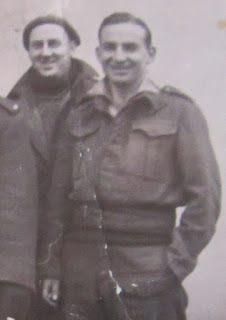

Les Dixon and Tom Walker, Oflag XXI B, Schubin, 1942. Courtesy of Anne O’Byrne.

Syd Wickham and Justin O’Byrne, Oflag XXI B, Schubin, 1942. Courtesy of Anne O’Byrne.
As Syd recovered from his non-combat wounds, others displayed more success on the ice rink. After having ‘a very good Christmas here despite being behind the wire’, Colin Phelps noted that ‘the big ice rink is in full swing and we had music from an amplifier’. So popular had the rink become that, three days after Christmas, ‘there was skating while it was snowing’. There was also a ‘small fun fair using cigarette currency. I won seven hundred on a horse race’.

Colin Phelps, Stalag Luft III, 1944.
As his first Christmas in captivity loomed, North Compound’s Alec Arnel was looking homewards and, on 11 November 1944, imagined that his school teacher sweetheart, Margery, would be ‘thinking of Xmas and a well-earned vac[ation]’. His thoughts then returned to Stalag Luft III and a Christmas with few of the trimmings. ‘Mmmm. I could go for a turkey and plum pud in a big way. Talking about pud our parcel shortage has called for ingenuity in the cooking department. One outcome is a Reich-bread pud which has to be seen to be believed. However it helps to fill the aching void.’ But an empty stomach was not the only void he felt. ‘Merry Xmas dear girl. Maybe there will come again a day when the world no longer lies between us at Xmas-tide.’ Alec ‘expected little in the way of Christmas cheer’ and a few weeks later was overwhelmed at his ‘amazing good fortune of receiving nine letters—and what is more important five of them were from the girl with the laughing eyes. These were my first letters in Kriegiedom’—he had been captured on 29 June 1944—and were all forwarded on from my squadron’. Christmas in a prisoner of war camp could never be like it was a home. Even so, the Kriegies did their best and, ‘on Xmas eve we held special church services and sang again the old carols. Our minds wandered far away and nostalgia caused this Xmas to be the quietest most reflective I have ever known’.


Alec Arnel with 451 Squadron Hurricane. Courtesy of Alec Arnel.
Ronnie Baines of North Compound, who had been captured on 18 November 1942, did not expect wonders from his third Christmas as a prisoner of war and, despite the long-term plans for the Messiah performance and the Christmas service, noticed that ‘very few prisoners made any attempts at a “Merry Xmas”’. He was not in a particularly jolly mood as he felt the pinch of the tight rationing. A typical December main meal—taken at 3.30 pm—consisted of two tins of salmon, some boiled spuds and cabbage, a packet of boiled prunes, boiled barley and milk and coffee split between eight men. By 11 December 1944, Ronnie was ‘feeling very hungry’ and was suffering a ‘terrific cold’. On the 23rd, they ‘received our parcels of food, American R[ed] C[ross] very good’ but, with their ‘tin turkey and pudding, sweets and a lot of junk’, they were both ‘too luxurious’ and not adequate. ‘No milk, sugar or biscuits, consequently our hopes of a big meal on Xmas day have been squashed—however we do appreciate what we have.’ In the event, Ronnie’s Christmas dinner, consisting of a six ounce turkey each, a half-pound pudding and tea was ‘quite satisfactory’. No stomach aches for his mess but there was a noticeable downside. ‘Unfortunately the aftermath was no meat for the next 2 days’.


Ronnie Baines, Stalag Luft III, 1942.
Ronnie Baines’ fellow prisoners may have expressed annual optimism that they would be home by next Christmas, but by the 27th, Ronnie was in a funk. ‘So another Kriegie Xmas passes, may even have another the rate the brilliant Allied leaders are charging into battle… Sometimes I wonder if we’re ever going to be released.’ Missing his wife, Irene, terribly and bemoaning the ‘miserable’ coal issue, Ronnie’s spirits hadn’t lifted by the end of the year. ‘Last day of 1944, a year full of big hopes and even bigger disappointments. New Year’s Eve passed uneventfully, no chirping around at all.’


Irene and Ronnie Baines’ wedding day, St Marks Church, Alexandria, Egypt, October 1942. Ronnie was captured on 18 November 1942. Courtesy of Stuart Baines.
Alec Arnel, perhaps feeling less ground down by captivity, had a more optimistic outlook. ‘Soon the New Year will replace the old. There is no doubt as to what my prayer will be. I think every soul who has been touched by war’s repulsive hand will cry “Peace!”


Back in Australia, a young woman was desperately awaiting peace. Evelyn Charles’ sweetheart, Eric Johnston, had gone missing in action on 23 June 1944. Nothing more was heard from him. There was only silence. Despite having no idea whether Eric was alive or dead, she wrote to him on 29 September. ‘It seems years since I have written to you my darling, but I know that by the time this reaches England you will be there to collect it, it’s been a long time but good news is coming through slowly and I am sure that it will be your turn next. … You know dear I am still holding out great hopes of you being home for Xmas.’ Despite knowing she was ‘a bit crazy writing these letters when I haven’t any definite news of you sweetheart’, Evelyn sent another on 2 October because ‘I just know that you are all right and that by the time these reach their destination you will have arrived back safely’.


Eric Johnston, 31 WAG course c1942.
It was a terrible time for Evelyn and, despite her family and work colleagues, she felt alone. So many others had to bear the same grief of not knowing what had happened to their menfolk—all the wives and girlfriends and families of prisoners of the Japanese—and she felt she had no one to share her desperation. Although not overly religious, she was drawn to Melbourne’s St Paul’s Cathedral for comfort. ‘I used to walk in there and I used to sit in the back of the church. There’s always people there, no matter what time you went.’ But one day, while she was sitting quietly, thinking of Eric and hoping he would return safely, her attention was drawn to a couple sitting further up the aisle. ‘She was breaking her heart. Absolutely.’ Evelyn didn’t know ‘whether they were mourning someone or whether they were missing someone. Whether they were like me’, and waiting for news. She wanted to approach them but ‘I couldn’t—maybe it’s all over for them and maybe they know—I wish I could talk to them’ but the raw emotion was too much for Evelyn. ‘I couldn’t stand it. So I got up, I went to work. I had a hell of a day at work, and do you know, I never, ever went back.’ And she didn’t talk to anyone about her despair. ‘You did it on your own. You had to.’


St Paul’s Cathedral, Melbourne. Lifted from ‘the web’ but I forgot to save the reference. Sorry.
What Evelyn did not know was that, after Eric was downed, he had been assisted by the French and then betrayed. He had been sent to Beauvais, Fresnes and finally to Buchenwald Concentration Camp. Somehow, the Luftwaffe discovered that 168 allied airmen had been incarcerated there in appalling conditions. After two months in Buchenwald, the Luftwaffe secured their transfer and Eric arrived in Stalag Luft III’s East Compound on 20 October 1944. It took a while for details to filter through official channels and, just before Christmas, Evelyn heard that Eric had been located. But she didn’t experience elation. ‘I don’t know that I felt anything. I was numb. It was lovely, he’s a prisoner of war. Fine. But is he still alive? Haven’t heard from him.’ And she still didn’t hear from him. ‘He didn’t write. They couldn’t write. I never got any mail from Eric. Not after he was shot down. Oh no, nothing.’ And then, on 30 May 1945, she received a telegram from Eric. ‘Repatriated to England … Am well and fit fondest love darling.’


Courtesy of Evelyn Johnston.
The war in Europe was over. The Australian airmen prisoners were liberated. Soon they came home and grand welcomes were held for them. Melbourne’s on 10 September for homecoming airmen, including 140 former prisoners of war, was particularly memorable. During a ‘triumphal procession’ the men were treated like celebrities and cheering crowds rushed the cars. ‘The airmen found themselves shaking hands, being kissed and patted, and congratulated while girls begged for sprigs of wattle from the airmen for keepsakes and as the cars moved off again the girls ran alongside still waving and cheering’.


The Argus (Melbourne),Tuesday 11 September 1945.
The formal reception was at the Melbourne Cricket Ground and Evelyn was there with Eric’s family. She broke away from his parents—they weren’t as fast as she was—and ‘ran up an incline to get up to where … all the boys were’. And then she saw him. And she can still see Eric, over 70 years later. ‘That was a day I’ll never forget. I can see it happening. I can relive it—I only have to shut my eyes and I can relive every second.’ They ran to each other and hugged and hugged, and laughed and cried. ‘There was quite a lot of family there to welcome him home’, but Evelyn was blind to them. ‘Don’t ask me who was there—I didn’t see anybody but Eric. … Didn’t see anybody.’ So intense was her joy at seeing her sweetheart again that ‘I don’t remember when I got to the point of allowing his Mum and Father to say hallo to him. I don’t. Really don’t. I must have, or course. I don’t remember.’ All she remembers is the elation of reunion and ‘the best day of my life’.


The Sun News Pictorial. September 1942. Courtesy of Evelyn Johnston.
A couple of weeks after Evelyn and Eric’s reunion, Bert Comber, who went straight to North Compound after arriving from Italy, wrote to his niece, Mary, from Shrewsbury in Shropshire. ‘Just now I am paying farewell calls to all of the friends I have in this country’ because he hoped that he would soon be on his way back home. He regretted how much he had missed both as an operational airmen and a prisoner of war. ‘While I have been away, your Mummy and Daddy have been sending me pictures of you all and I have noticed how my four little nieces have grown since I left home—Uncle Albert has missed so many of your birthdays and so many Christmases too’. But he hoped that 1944 would be the last Christmas away from his sister Win and her family, and told little Mary that he ‘will be home for this Christmas, and for all of them after that’. But on 10 October 1945, when he should have been ‘on the high seas bound for home’ he wrote to Win to say that ‘the ship I was to go on has been delayed until about 20 October because of the extensive strikes in the shipping world over here. At the moment there seems very little prospect of having these disturbances settled and sometimes I become a little alarmed about not getting home for Xmas—though it is most unlikely that I shall be delayed that long’. His departure was then delayed until 27 October. ‘There have been no departures since 27 September and I am now booked to go on 4 November and to arrive home about 5 December. We have been promised that all Aussies will be home before Xmas’. He didn’t really know whether to believe it or not. ‘The authorities over here have never been able to be really sure however about plans made ahead—such plans have gone astray so often because of complete uncertainty and sudden changes in the shipping position. But they are sure, they say, that things from now on will go according to plan.’


Bert Comber, Stalag Luft III, 1943.
But things didn’t go quite to plan for Bert. Sometime in October, he met and fell in love with Eve. They married on 1 November and shortly afterwards, he finally embarked for Australia, and celebrated Christmas on board the Athol Castle. He arrive in Melbourne on 3 January 1946, followed soon after by Eve.
Once back home, all former prisoners of war—including the Australian Kriegies of Stalag Luft III—tried to put aside their time as POWs with varying degrees of success as they embarked on their new, post-war lives.


Alec and Margery Arnel, Wesley Church, 8 October 1945. Courtesy of Alec Arnel.

Charles and Beryl Fry, 22 September 1945, Christ Church of England, Bexley, NSW. Courtesy of Pat Martin.

Eric and Evelyn Johnston, 15 June 1946. Courtesy Evelyn Johnston.

Evelyn and Eric Johnston. Still in love. Taken from the documentary, The Lucky Ones: Allied Airmen and Buchenwald, released in 1994, 50 years after Buchenwald.
I include a link for one of my favourite Christmas carols. It is a newish version of The Little Drummer Boy by my favourite singer and his Christmas guest, David Bowie. It includes a special wish for the peace that Alec Arnel called for, and which all of the men mentioned in this story—and their comrades—fought for.

https://www.youtube.com/watch?v=ADbJLo4x-tk


